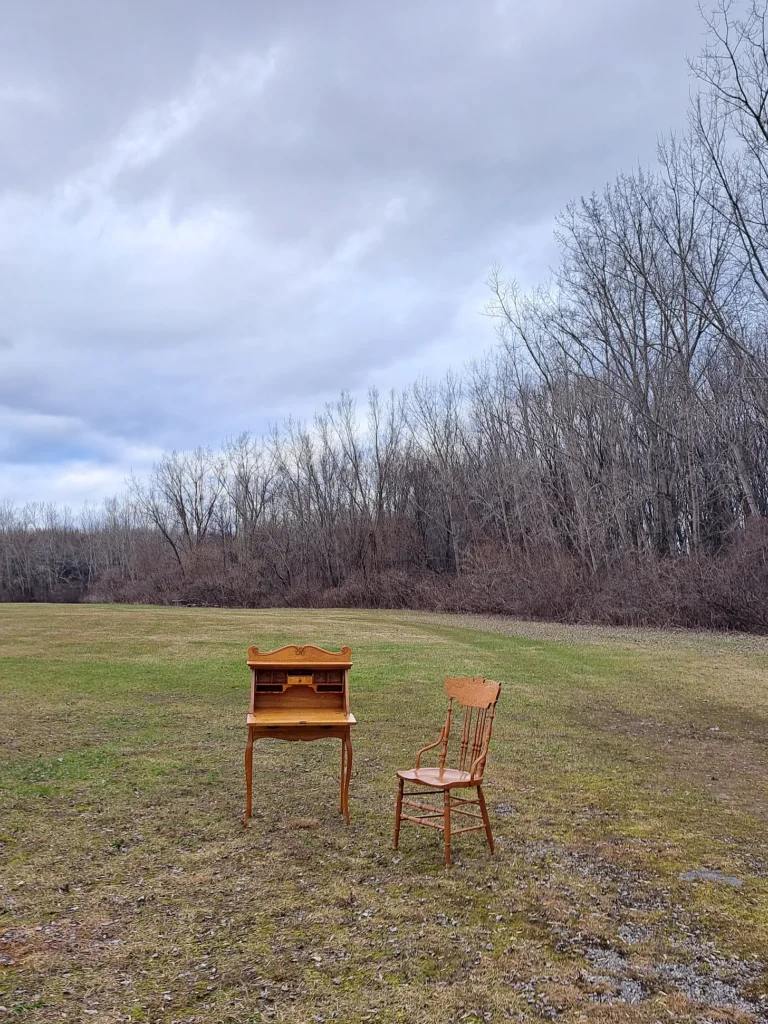
Stumps and Roots
Dear Fellow Dreamer,
Long ago, I remember hearing an interview with another writer who, when asked if she was working on a new book, laughed and rolled her eyes. “Oh, I don’t know. Each one requires so much of me. It takes me years to finish.”
For better or worse, I guess I’m that kind of writer. Only I do know with certainty that, yes, I’m getting started on my next book. Why? Well, that’s a mystery I can live with. Why do any of us feel drawn to follow a dream?
Rumi said, “What you seek is seeking you.” Over the decades, I’ve found that trusting in the Sufi poet’s maxim makes things simpler. Not always easy, and not perfect—there’s no such thing. But more fulfilling and joyful.
Over the past weeks, I’ve been immersed in the “final polish” stage of editing my soon-to-be-submitted novel manuscript, River of Dreams. This picky phase can be tedious. Yet like the others, it’s a stretch filled with a tough and abiding love. What makes this moment a little different is the readiness to let go.
In the spirit of honouring the process that any one of us goes through in finishing a creative project, I’m sharing a few poems with you today. Written over two decades ago, they point to the inspiration behind River of Dreams—one deep inside my bones. These pieces also form the continuation of an earlier post, “The Haunts We Seek.” For context, here’s an excerpt from it:
“In her thirties, my great-grandmother Jessie, a dynamic woman with a keen intellect and artistic sensibility, suffered depression after undergoing a procedure to remove a tumour. The operation had resulted in a complete hysterectomy, and Jessie’s sadness didn’t lift. Upon her doctors’ recommendations, in 1910, she was committed to Montreal’s Protestant Hospital for the Insane where she lived until 1960, when her body was returned to the Townships.
“Eventually, I’d come to recognize that the effects of that trauma had remained in my family—the effects of one mother’s long-ago removal and disappearance. For that reason, as a writer, I’ve felt compelled to explore 20th-century treatments of institutionalized women and their families. One of the settings in my forthcoming novel, River of Dreams (2026), is a 1920s mental hospital.”
While the manuscript I’m in the last days of completing is not about my great-grandmother, it is dedicated to her. And to all the women who vanished.
From my book, In Green, published by Guernica Editions © Robin Blackburn McBride
Stumps and Roots
Something makes me step back
Over the raised doorsills of time.

I step
without stumbling,
careful not to let others hear,
avoid rusty nails
strangers
poison fruit.

I shrink
to the size of an unpricked finger,
move cautiously over the pages
in our fairy tale collection.

Here is a picture of the girl with her basket.
How can I tell my daughter, who I read to,
that the child we see on the page is me?

Walk anyway
past stumps and roots
to where parents lose their young
in shadows
and a bear could snap a neck
like wood.

Crawl
into the house
too snug
for my skin.
Bones pressed tight
in lath and plaster swaddling.

My ancestor draws me
calls me to reach in
to where each small detail looms.
Her life played out in whispers here,
a forest warning.

In childhood we are closest
to the ghosts that formed us.

I must go back to know better
where I came from.
No need to mark the trees
with the tip of a silver knife.

I recognize the way.
Wedding Gift
My father hauls the desk,
a relic wedding gift
from a farm on the Eleventh Range.

They whip along highways
wind-beaten through two provinces
to the refinisher
who holds it fleetingly in acid hands
and sends it on—
my Toronto door blown open.

My father explains how they did their best
to eliminate strike marks
and other scratches on the surface of the boards.

“The grain has come up quite nicely,” he says.

Keys once lost
have been replaced.

Doctors’ letters locked inside
pronounced the bride’s fate years ago:
the necessity of her early parting
contradicted the craftsman’s symmetry.
Stark words have been removed

before the wooden legs are carried
across my threshold.
Letters
Asking my father for the letters that were shut away
plays out a family
song of dread.

I am aware, as I make the call,
of how he might respond.
Numerous throat clearings,
shovels full of earth.

In my mind
the two of us stand
eye to eye,
spade to spade,
silhouettes
on an unnamed field.

He knows that when he leaves I will stay,
that where he has filled
I will dig.

There is respect in the turning of a back
and trust in walking,
the sound of metal
hitting objects
underground.
Harvest
I discover she was exiled
for sadness
and I wonder if she chose her ride.
Each time her husband came to visit her
she cried
and they sent a letter after him.
One day he stopped.
Went back to ploughs
that were easier to pull
than her heart behind him.

The source of her pain
remains
undocumented.
I could search through all the pages
and never find her sorrow spelled in words.

Somewhere the woman’s heart
found a place to hide
from all who had marked it.
Furrows scored deep
in the silent land of muscle
she harvested
alone.