A Story, Book Love & News
Dear Fellow Dreamer,
In February 2017, two nights before we were scheduled to fly to Bali, my husband and I set fire to our house. It was an accident of course. A metal cap on the floor of our hearth had rusted through—undoubtedly due to the leak we’d tackled a few months earlier, after moving in. Having the cracked old chimney taken down and replaced was our first big home improvement. One that had made us feel like the property’s true owners and given us a pass to use the fireplace. Or so we’d thought. Under the ashes, no one (including the repair crew) had noticed the holey cap.
At midnight, as we sat reading by the fire, when smoke began billowing up through a register, Hugh bolted to the basement where a section of the furnace room was blazing. Holding his breath, he lunged for a flaming box. It had been stacked on a pile of other smoke-enshrouded boxes, beside another pile, and another, against a now-scorched wall by the ash chute we’d believed was sealed. Grabbing what he could— “Billie Holiday,” our twelve-year-old semi-molten torch of a Christmas tree—Hugh fled. Up he ran with the boxed, burning Billie, the two of us struggling not to inhale toxic haze as Hugh pitched the tree through the open front door and I spoke with a 911 operator who said, very politely, “Get out of the house!” We did. Standing in the snow gave us time to think. How much more was on fire in the basement? Were we too late? And what were the odds of inheriting a family home and just as quickly burning it down?

Never have the sirens on six EMS vehicles sounded so good—a band of angels singing along our street as we waited beside a smouldering bin-stuffed snowdrift. One by one, the neighbours’ lights came on. Sami from two doors over, who’d grown up in a country at civil war and likely knew a few worse things than house fires, came out to meet us. He shovelled our walk for the emergency workers. He stood with us, smiling, offering us a place to stay. As grateful as we were for our neighbour’s invitation, once the fire fighters had finished, we were all relieved we didn’t need to take him up on it.
Since that night, our fireplace has remained strictly decorative. While we’ve missed the hearth’s glow and often talked about fixing it—would we restore it to safely burn wood, or retrofit it with an insert? —each year, more pressing home improvements have taken priority. On winter evenings in the living room, I light a few candles.
In ordinary reality, sometimes extraordinary things happen. We were a couple who urgently needed a home inspection, and thanks to a house fire—our wake-up call and second chance—we had one done in time to prevent further calamities. Now I’m a woman who reads late into the night in front of a non-functioning fireplace. But the imagination is powerful. In my head, sometimes our hearth looks like this…
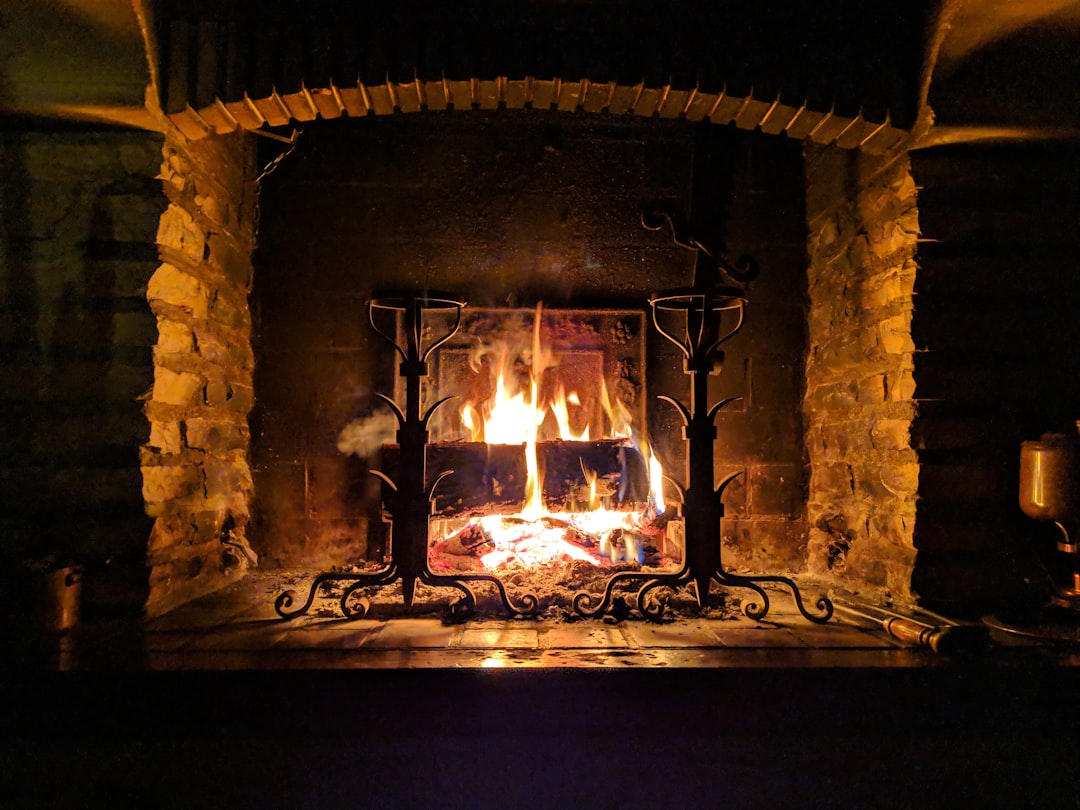
As promised, this week I’m sharing a bit of news. But first, I’ll tell you about some reading I’ve been doing by the dancing fires in my mind.
Fiction
Elaine Feeney’s Let Me Go Mad in My Own Way pulled me in and held me spellbound. I loved this multi-generational family story set in the west of Ireland. In the opening pages we meet Claire O’Connor, a woman returned home from the life she’s carved for herself in London, to her family’s farmstead in rural Athenry, several miles from Galway City. Claire is a university professor and writer haunted by her past. By her mother’s sudden and perplexing death, and the shame of not having been there for her. By childhood memories that refuse burial. And by the ruin of her relationship with Tom Morton, the man Claire loved and lived with in London—one she drifted from while in the throes of a mental health crisis following the deaths of both her parents.
Throughout the novel, Feeney takes us back and forth through time. In the contemporary plotline, we find Claire living alone in the bungalow where she grew up, and where, during the Pandemic, she regains stability through routine. Claire begins teaching again, this time in Galway. Scrolling Instagram in her off hours, she becomes fascinated by the accounts of twenty-something trad wives. Why? All the while, she puts her mother’s house in order. When Claire discovers that Tom has moved to a nearby town, we wonder what will happen. But this book is complex. It’s much more than a romance genre page-turner.
There are two other stories within the story…
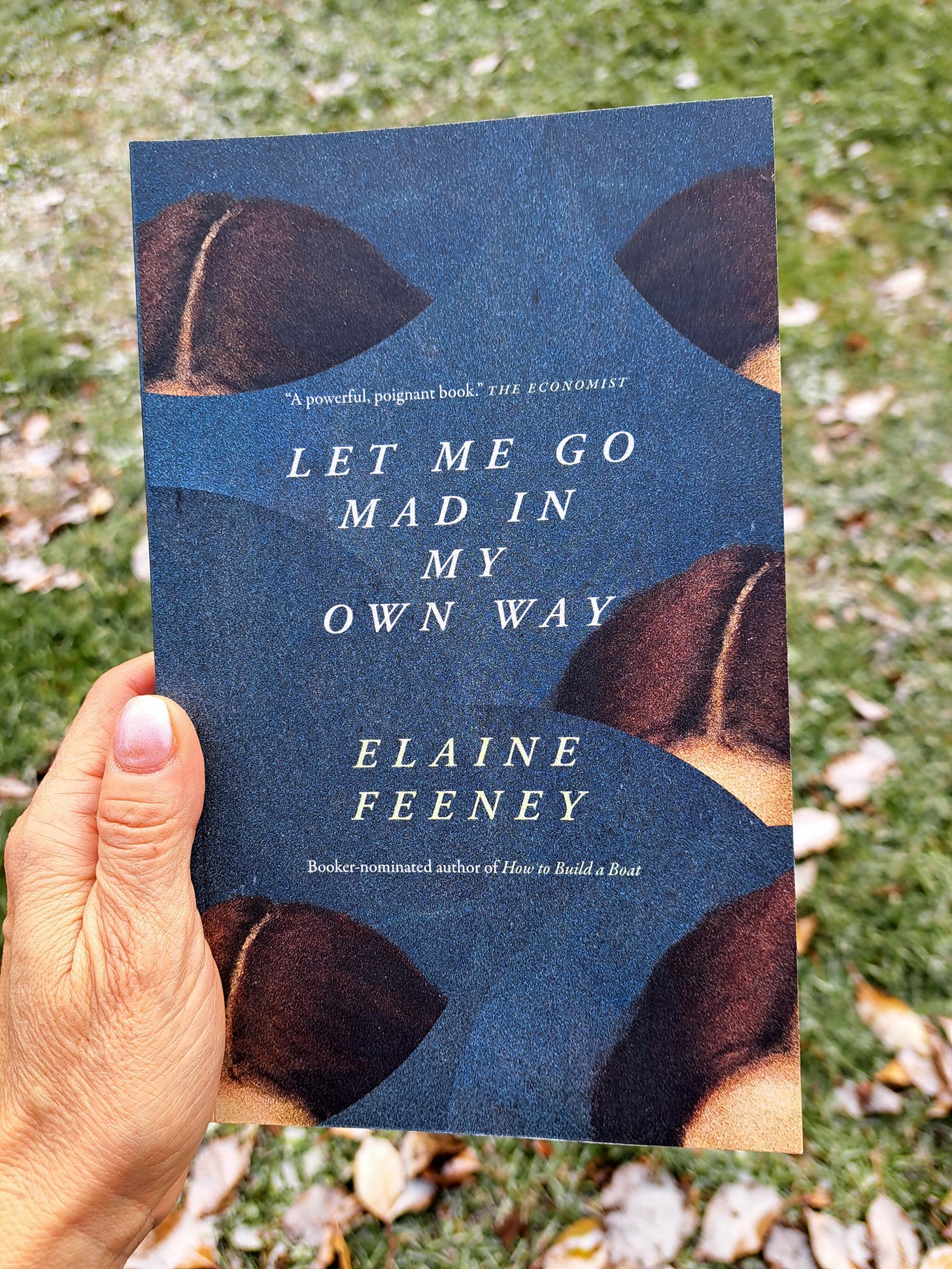
The second of three plotlines takes us back a hundred years to the “Old House” on the O’Connor property, a barren structure that the contemporary Claire stares at through a bungalow window. By 2022, the Old House has been long abandoned. In 1920, we meet the family living there—Claire’s great-grandparents Lily and Paddy, and their sons Jack, Thomas, and Pat. With its turf fire and busy kitchen, a loft for sleeping, and two small square windows, the house comes alive with the sights and sounds of a summer evening. An evening that’s making Paddy O’Connor unsettled…
The third story is set in 1990, a year when we see young Claire at home during adolescence. We meet her parents in their prime, and we begin to understand why both the Old House and the bungalow hold secrets.
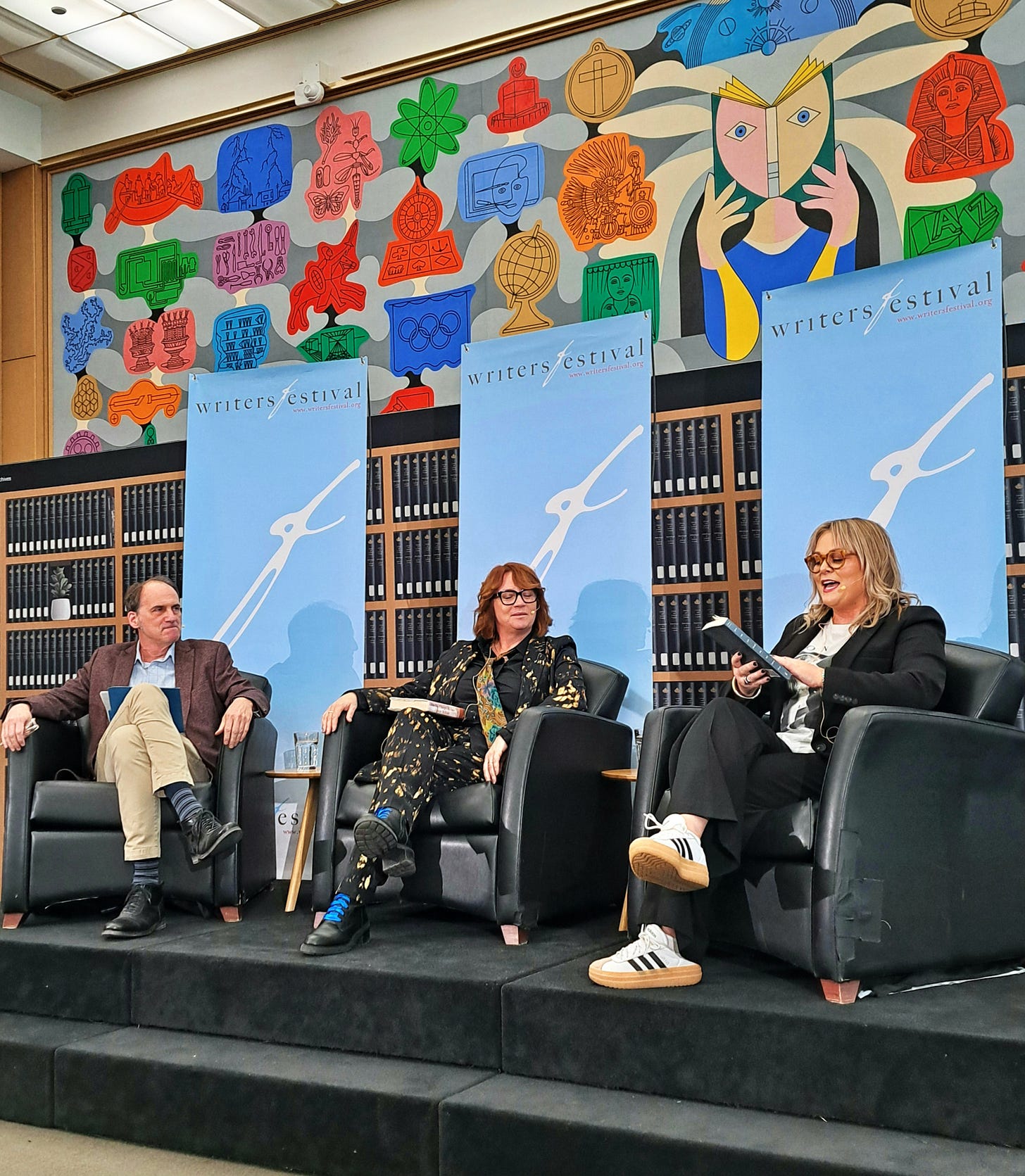
Like any good work of historical fiction, Let Me Go Mad in My Own Way tackles issues relevant to our time. Last month at the Ottawa International Writers Festival, Feeney talked about what it’s like to live in the Irish home she grew up in, and how her small house sits in close proximity to other houses of her ancestors. Writing a novel about a character who, like the story’s author, also gazes upon old structures led Feeney deep into research on 1920s Ireland—specifically, the “blackandtans,” men recruited to serve the Royal Irish Constabulary during the Irish War of Independence. This is a book about colonialism’s long shadow. It’s about shame and human rights—in particular, women’s rights. It’s about the repercussions of abuse. But it’s also a novel filled with quirkiness, fierce resiliency, and humour. So often, the dialogue and Claire’s internal musings made me smile. While listening to Feeney read aloud, her voice and the voices of her characters convinced me to bring this novel home.
More Book Love
If you’ve read my last couple of letters, then you’ll know I’ve been in a holy tryst with the writings of Frank MacEowen. Twice I’ve mentioned The Mist-Filled Path: Celtic Wisdom for Exiles, Wanderers, and Seekers, a text I highly recommend. I’ve also enjoyed MacEowen’s The Celtic Way of Seeing. And since my last letter to you, I’ve begun reading his book The Spiral of Memory and Belonging. What I love about MacEowen’s nonfiction is not only the way he imparts wisdom, fascinating stories, and points of entry to traditional lifeways, but the author’s inclusivity. In his writing, MacEowen shows respect for many groups and soul-honouring traditions. And here’s a fun fact. This past week, in a YouTube interview, I discovered that in recent years MacEowen has been going by a different name, Frank Inzan Owen; and under his birth name, Frank LaRue Owen, he has devoted himself to writing poetry.
On the subject of devotion, last month in an online writing group, I met Annie Wenger-Nabigon, Ph.D., a dual citizen of Canada and the United States, and a retired therapist and professor of social work whose publications have appeared in many professional journals. At our gathering, she shared that out of a pressing urge to “get the story out,” she’d just self-published her first work of historical fiction. While listening to Wenger-Nabigon describe her novel, my fingers were busy, as on another screen I was placing my order. Her book Pipe follows the centuries-long journey of a “deep green stone in the shape of a carved pipe bowl”—an Indigenous artifact sacred to an Iroquois-speaking people from the Susquehanna River region of Pennsylvania. The Susquehannock were known to English-speaking settlers as the “Conestoga Indians.” In 1763, in an act of political terrorism, they were massacred.
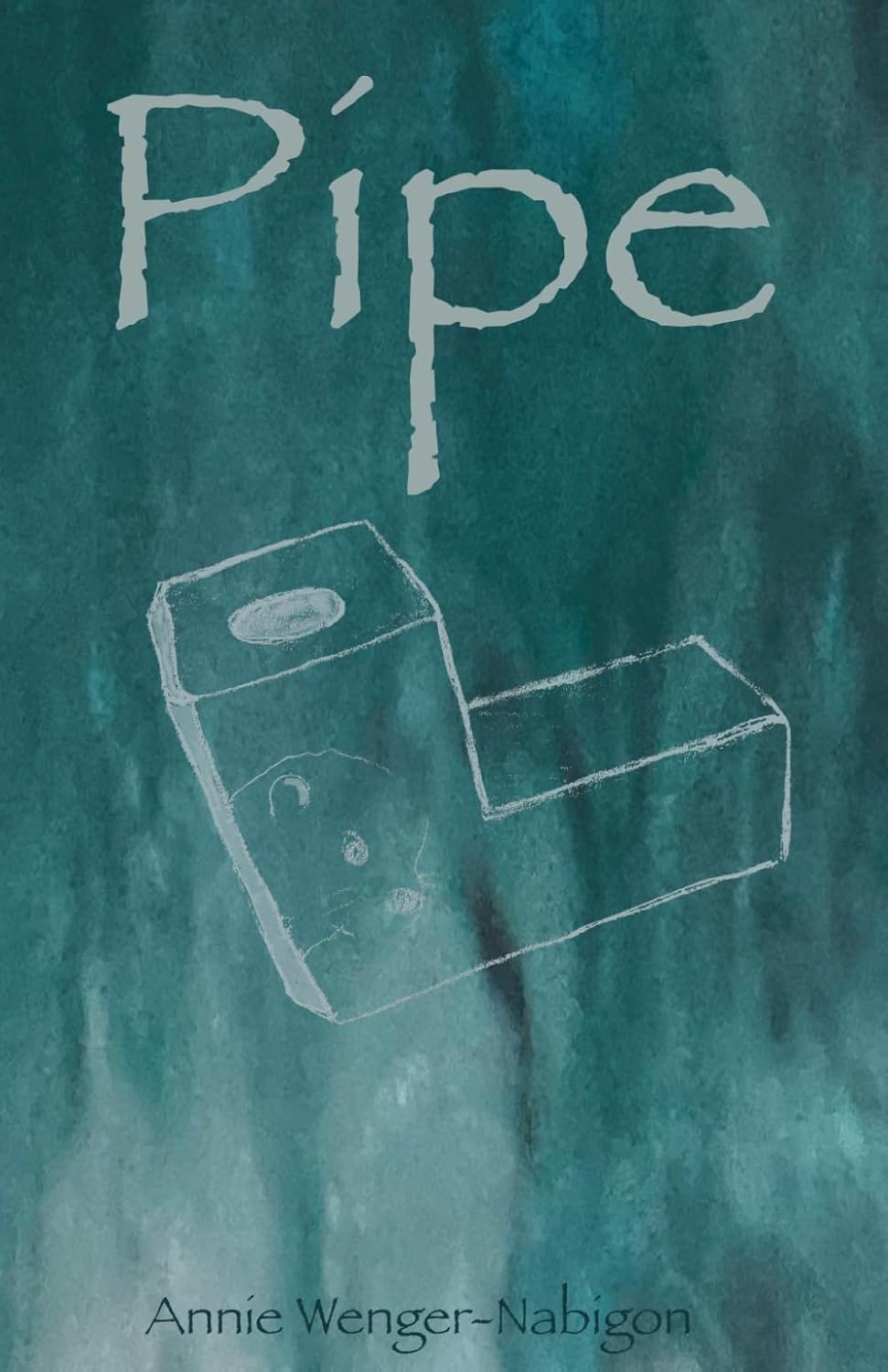
Wenger-Nabigon’s novel tells the story of how the pipe was discovered and passed along through generations of a mixed-heritage family—part Conestoga and part Mennonite. We follow the journey of the sacred vessel with its otter carving from the US into Canada. Spanning lifetimes, the tale is episodic, as Wenger-Nabigon’s characters come and go. She describes events in prose accessible not only to adults, but to younger (YA) readers. Overall, I found the work absorbing and at times quite moving. “The novel reflects intense concern for environmental challenges facing the planet, and a spirituality deeply rooted in respect for the natural world.” While reading Pipe, I also came across articles on related current events—how Pope Leo has promised to formally return Indigenous objects held by Vatican museums to Canada, and how a sacred pipe has been returned to Whitecap Dakota First Nation after being held in a Saskatoon family’s private collection for years.
Here are the names of a few other books I’m currently reading and cherishing:
- On Wholeness: Anishinaabe Pathways to Embodiment and Collective Liberation by Quill Christie-Peters
- Ajar: Poems by Margo LaPierre
- The Pollination Field, poetry by Kim Fahner
- Like Water for Weary Souls, a cozy mystery by Liisa Kovala
What books are you reading and cherishing these days?
November News
1. On Sunday, November 30th, from 1 – 3:30 p.m. Eastern, I’m hosting an online workshop called Writing with the Ancestors. If you’re curious, consider yourself invited. You can find all the details in my last newsletter and also here, on the event registration page. So far, several writers have signed up, and we’re a lovely group! There’s still room for a few more. Would you enjoy exploring new ways of sparking imagination and creativity, being part of a warm and spirited, supportive gathering, and bringing your own ancestral stories into form? If so, I hope you’ll join us.
The investment for this workshop is $45 CAD. If you are currently experiencing financial difficulty, you’ll find a sliding scale on the registration page. Reach out if you have any questions. Important note: If you purchase an Annual subscription to Awakening Wonder ($80 CAD), you will automatically receive the workshop at NO additional cost. Also included in the full-year paid plan is a 60-minute private Zoom consultation with me. (This one-to-one meeting is not the same as the strategy sessions I have given in the past.) As a multi-genre, traditionally published author and working writer, as well as a longtime teacher and coach, I offer a unique skill set. During our hour together, we will focus on the area of your creativity where you would MOST love greater clarity and support.
To purchase an Annual paid subscription and enjoy all the benefits, including the upcoming Writing with the Ancestors workshop, go here:Subscribe
To enroll in the November 30th Writing with the Ancestors workshop, visit the event registration page. If you click the button below, you will need to use the back arrow to return to this post:
2. Tomorrow (Saturday, November 22nd) from 12:00 —5:00 p.m. I’ll be selling books and meeting other readers and writers at the Ottawa Small Press Book Fair. This is always a fun event! If you’re in the area, come join us at the Tom Brown Arena for lively conversations, quiet browsing, holiday ideas, and your next great reads.
3. On December 2nd I’m honoured and delighted to be the featured poet at Poetea, a reading series in Wakefield, QC. The event will take place from 7 – 9 p.m. at the Biblio Wakefield Library, a short drive from Ottawa. My reading is called Thin Places.
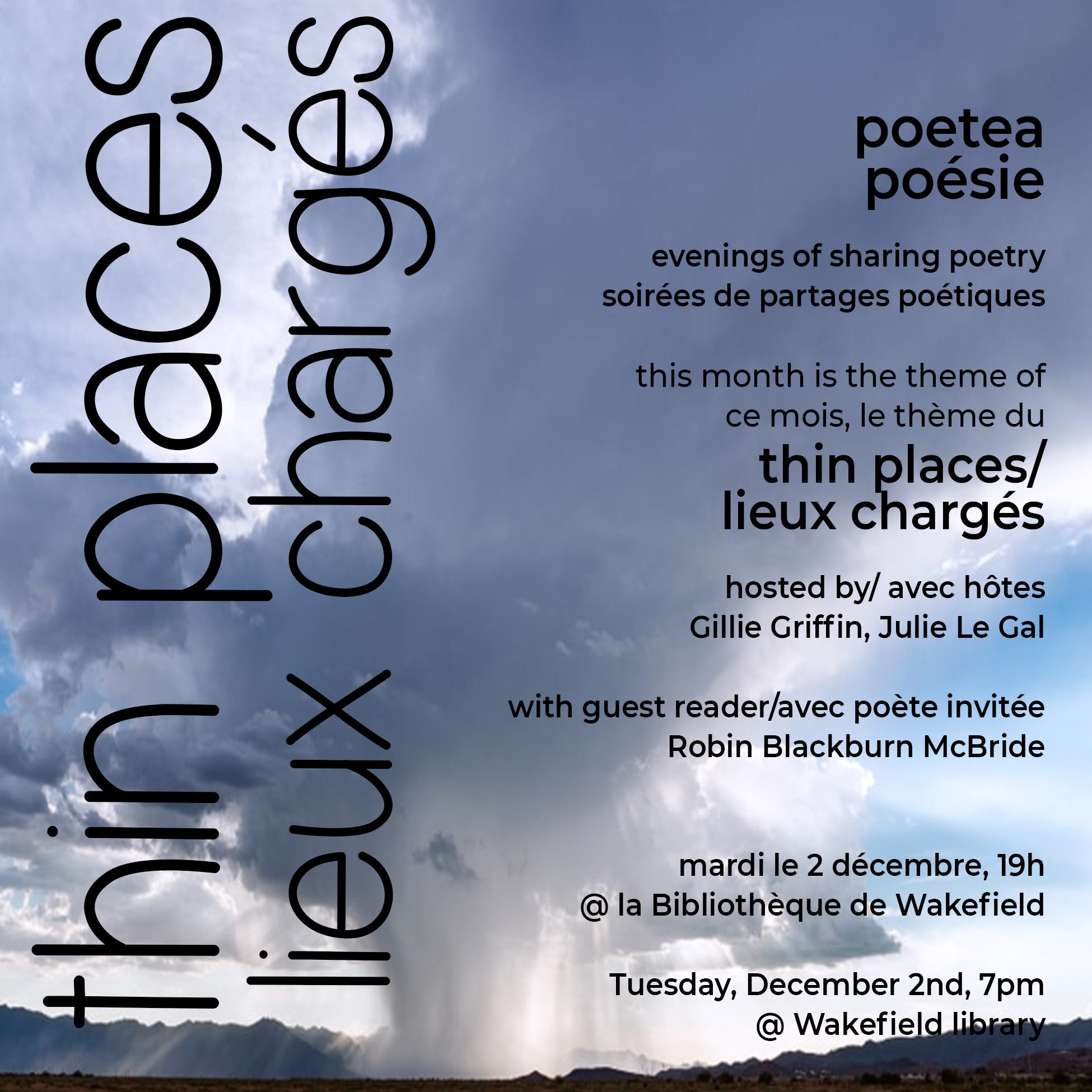
Here’s a description for those interested in attending, including other poets who may wish to take part in the open-mic segment near the end:
Many consider “thin places” to be locations on the land where the boundary between this world and the next is so slim as to be porous. As poets, we can be creative with that notion of crossing into other worlds. Life offers us a variety of threshold moments and “spaces.” Charged places—not only in the physical landscape, but our interior life. In time—with sudden shifts in awareness. In relationships where the borders between us blur. In memory where the veil between the present and past thins. In dreams. Where, in your life, have you found yourself moving between worlds? Think about poems that point to liminal states and experiences. Perhaps a glimmer of the numinous.
On that note, I wish you a happy start to the holiday season. Look for my next newsletter one month from now, once I’m back from some pre-Christmas adventures with my family in southwestern Ontario.
Stay warm, but don’t burn down the house.
With love,
Robin